Blog

Wellness, Well-Being Trends vs. Aquatic Bodywork

Why Aquatic Bodywork Is Here to Stay — An Opinion

The world chases the next trend. Water reminds us of what we’ve forgotten.

In recent decades, the global desire for personal growth has expanded rapidly. More individuals are seeking to slow down, create meaningful change, reconnect with themselves and their environment, recharge, and find new ways to balance their priorities. People want depth instead of speed — practices that bring clarity, nourishment, and presence into daily life.

In this evolving landscape, two terms frequently surface: well-being and wellness.

What Is Well-Being?

Well-being is the broad and ongoing state of physical, emotional, and social harmony. It reflects a life with balance, purpose, resilience, and inner coherence — not a fleeting moment of happiness, but a sustainable alignment and a grounded sense of peace.

What Is Wellness?

Wellness refers to the habits, choices, and practices that support that alignment — movement, nutrition, breath, meditation, somatic awareness, complementary therapies, mind–body tools, and spiritual exploration. Wellness is the active pursuit of health and harmony.

As world wide interest rose, all became instantly available with a single click. Studios, retreats, workshops, healing modalities, somatic experiences from diets and nutrition through approaches of mobility and breath work, therapists and coaches — everything grown and multiplied. Studios, retreats, workshops, healing modalities, and somatic experiences multiplied. 

What once felt rare or innovative became familiar. Wellness became a language spoken by many. Like every trend, each approach at its time and timing either climbed up or slowly faded in but, everyone was doing something for their well-being but not everyone is feeling transformed.

The Element That Always Stays

Through all these waves, water remained constant — quiet, ancient, and easily overlooked. Yet water has always been woven into the human story. It shaped our beginnings, our biology, our nervous system, and the architecture of our emotions. Water doesn’t follow trends. It shapes them, dissolves them, and outlives them.

Aquatic bodywork as a wellbeing addition to the wellness world first emerged in the 1980s and has expanded professionally ever since.

Today hydro-somatic approaches: the warm-water aquatic bodywork or cold immersion are recognized worldwide for their measurable and deeply transformative effects.

Why? 

Because water is the only element that engages the entire spectrum of wellness — physical, emotional, sensory, neurological, and spiritual — simultaneously.

No studio or technique can replicate the multi-dimensional intelligence of water.

The Multifaceted Intelligence of Water

Water reflects and teaches breath. Every inhalation lifts the body; every exhalation creates a gentle descent. Whether floating or immersed, breath forms a dialogue between lungs, muscles, buoyancy, and gravity.

Water guides us to the edge between lightness and sinking, movement and stillness, balance and surrender. It invites resistance and release, influencing circulation and the relaxing of deep fascia — reaching connective tissues where emotion and memory reside.

Water awakens ancient memory. Floating shifts brain waves into states of deep meditation, somatic repair, and expanded awareness. The mind becomes porous — more receptive, intuitive, and able to access quiet inner landscapes.

Above all, water holds. Through temperature, pressure, and weightlessness, it creates conditions for emotional unburdening, trauma release, and nervous system recalibration. It offers safety not as a concept, but as a physical experience.

Water does what no single method, technique or coach can do alone.

Water Matters — The Human Blueprint

We live in a time of overstimulation — full minds, stretched nervous systems, guarded hearts, tired bodies. Trends promise transformation yet often add another layer of choice, comparison, and complexity.

Water cuts through all of it. It requires no performance, no perfection, no prior knowledge. It meets the body exactly as it is. It softens what is rigid, amplifies what is quiet, reveals what is hidden, and restores what is tired.

Water is not optional in the human story. Water is origin. Water remembers. Water is where we meet ourselves again.

This is why aquatic bodywork is not simply another wellness offering. It is not “next to” other approaches — it naturally becomes prior because it speaks to the human blueprint itself.

It is one of the rare therapeutic environments where body, mind, and spirit receive equal attention, effortlessly and at once.

Trends rise and fall. Water stays. It heals not because it is new — but because it has always been true.


We invite you to explore previous blog posts and learn more about the profound benefits of therapeutic encounters in water, and the unique ways they support transformation, resilience, and embodied well-being.


Flothetta's Special Offers

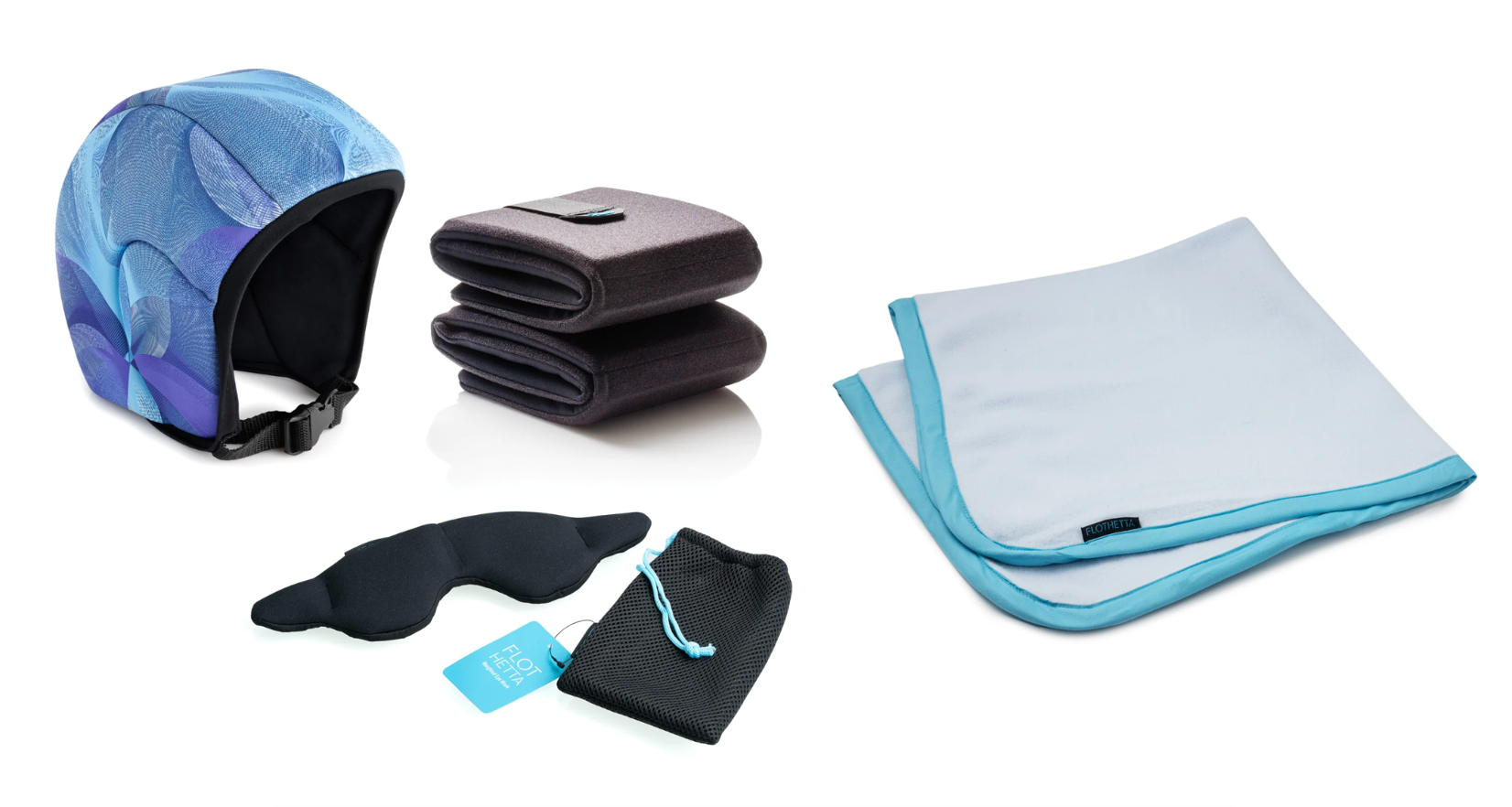
Universal Practitioner Float Therapy kit.

Offering you the the essential gear to begin and progress with one-on-one ‘class’, or you might find this opportunity to purchase your second set for one-on-two ‘class’.

The kit holds: float cap and classic leg support, weighted eye mask and a blanket. Suitable for students completed level 1 and level 2.

If you are one of our students contact us and claim your discount by inserting a promo code.

Practitioner Pillows Kit.

A great way to expand your float support toolkit. Select any of two pillows of your preference with a limited-time 20% discount. This offer allows you to strengthen your toolkit and enhance the float experience.

Classic pillow, “H”-pillow, Extension pillow: 15% off price discount.

If you are one of our students contact us and claim your discount by inserting a promo code.

The Composition of a Treatment (~Previous Blog~)

No two people are alike, and no two treatments are ever the same. Every session tells its own story.

Therapy is a complex encounter — a meeting of one individual with another, a meeting with the self, meeting with the water as environment. A meeting of individuals as part of a group and a meeting with life itself as a mirror.

Protocols offer practitioners a path to follow — welcoming, intake, the therapeutic process, ending and farewell. Yet in between lie smaller encounters, micro-moments hidden within the major stages.

During intake, for example:

How does the person arrive at the session? How do we receive them? Do they begin to speak while we listen, or do we invite questions and initiate guidance? Do we notice their movement through the space — their voice, posture, vitality, and presence? Do we allow time before entering the water, or do we jump straight in?

In the water:

Do we work on autopilot, focusing on our treatment routine patterns? or do we compose a balance of motion and stillness, balancing between space and time? Are we attuned to time — and if so, whose time? The client’s or ours?

What comes first? What matters more, and what matters less?

As practitioners, what do we choose to leave out — and what do we choose to add?Asking questions throughout the session keeps us alert and attentive, connected to the person, the group and to the water. These questions shape the composition of the treatment.

The way the practitioner moves in the therapeutic space, the quality of their actions — these already lay the path toward realizing the session’s potential. It’s not about how much we do, but about what we do and how we do it.

In one session we may include more; in another, we may let go. Every part of the treatment has its importance. Every action sparks a response. All together, they form the chain of the therapeutic process. As practitioners, we are obliged to adapt.

Questions and questioning, actions and adjustments, intuition, space, and time — these are the ingredients with which we compose the treatment. The more tools a practitioner has, the more grounded and confident the therapeutic path becomes.

Yes, a treatment has structure and boundaries that we must uphold. But within that structure, everything must be tailored to the individual. As long as we work within the agreed timeframe, with sensitivity and empathy toward the person before us, the essential commitment is fulfilled.

Composition is not just the transition from one movement to the next or the flow between them.

The composition of therapy is a dialogue and a dance — between people, between micro-elements, between fractions of seconds. It moves between what is and what is desired, between the “here and now” and “dream time.”

It is an invitation into a process — a path toward change.


Why Do We Move the Way We Do? (~Previous Blog~)

 Reflections on Movement in Aquatic Bodywork and Therapeutic Aquatic Practice

“Movement is life. Life is a process.  Improve the quality of the process and you improve the quality of life.”  Moses Feldenkrais                                                                                                                                                                                 

As Aquatic Bodywork Practitioners have you ever paused for a moment and asked yourself — why do I move the way I do?

As human beings in motion, we are constantly expressing ourselves through movement. But how often do we stop to observe the quality, the intention, and the origin of our gestures — especially when we are in service of another?

In the context of Aquatic Bodywork, movement is more than just physical technique. It’s communication. It’s touch. It’s presence. Whether we are floating someone in warm water, supporting them in stillness, or guiding them (body-mind-spirit) through motion, our movements carry meaning. They can soothe, awaken, protect, or challenge.

But the real question is — where do the movements come from?

Are our movements shaped by habit? By ego? By an “inner script” — movement patterns we’ve written over years of training, personal story, and embodied experience?
Or do they arise from a deeper place of listening — to the water, to the body we hold, to the silent language of another nervous system speaking to our own?

This is not just a technical inquiry. It is an invitation into self-awareness. A call to explore the intersection between intention and intuition, between what we think we’re doing and what is actually being received.

In movement psychotherapy, we often speak of how motion reflects emotion — how every gesture can reveal something of our internal landscape: defense, resistance, fear, control, tension,  softness, joy, compassion or heart opening. From a physiological perspective, movement stimulates circulation, supports regulation, and helps integrate body and mind.

But in the water — especially in a therapeutic space — movement becomes something even more: a dialogue. A shared language between body and environment, between giver and receiver, between self and other.

So please, the next time you enter the water — as a practitioner or aquatic bodywork student — take a moment to observe your own movement:

  • Where does it begin?
  • What is your positioning in the water? Are you above the surface or at water level?
  • Are you grounded and stable, or slightly off balance?
  • Are you moving in a continuous free-flowing way, or are you introducing new, intentional movement elements?

Each of these choices already shapes the movement you’re creating.

And when the movement is transmitted to the receiver’s body, ask yourself:

  • What is guiding this movement — your training, your habits, your ego, or the needs of the person you’re holding? 
  • Is it fast or slow? Intense or soft? 
  • What’s the quality of touch — clear, vague, hesitant, confident? 
  • Are you repeating what you know, or allowing something new to emerge in flow?
  • Does the movement serve the body, the mind, the spirit — or all at once?
  • Do you understand what the movement contains — vectors, tissues, joints, intentions — direct and apply or is it spontaneous and intuitive?

All answers are welcome. There is no single truth, no one correct way. What matters is that you are asking — showing awareness, responsibility, and commitment.

Sometimes I observe — in real time or through the lens of social media — how movement is presented and performed. And I gently ask: Who is this serving? This is not about judgment. It’s about remembering. A gentle invitation to return to awareness.

Because movement is more than mechanics, looking good, or doing a job.
It’s meaning.
It’s a memory.
It’s medicine.

Every movement we offer in water carries a message. The more we listen before we act, the more healing we allow.